Week two was quite a mouth full. We had a guest speaker, Laura Vandenburgh, give us a talk about drawing and I found it to be quite interesting. We were assigned a reading, which I found to be fun and easy to read (I know, even I couldn’t believe it). Last but not least, I was to learn about Margaret Kilgallen, a contemporary print maker.
I found Professor Vandenburgh’s lecture on drawing to be enlightening and fun at the same time. As a person, I simply just enjoy being showed slides of beautiful images; just to have them their on the wall, and for me to stare and ponder about every detail that forms this image. What I understood from her was that there is no one type of artist, that the boundaries of “what field do you specialize in” simply merge together. One can be a painter, but can be painting on a sculpture. An example of this, is the “Wire sculpture,” where the artist attached a wire to the wall and drew a perceived shadow of the wire using a pencil. Question is, what kind of art is this? Is it a drawing or a sculpture? Thinking about this will probably damage a large part of my brain, so I would rather simply state that this is “art” (and I’d rather not get into the discussion of what is art, because it will probably kill the other half of my brain). Basically, I learned that a medium can be anything; like a pencil, hair, or even an idea.
 An observation I noticed about much of the art work that Professor Vandenburgh showed, was that the art work had to be looked at as a whole. If you simply examine a small part, or cut out a part it will rob the image of its glory. It is like a jigsaw puzzle, th e little pieces won’t make sense alone, but if you combine them they form something tangible. An example of this would be the red ball point pen intestines. If I tear a small piece from it, like the size of my palm, I wouldn’t have a clue what it was. I can’t take it out of context. It reminds of some photographs I have seen a few months ago of Muslims performing a prayer around the world. The photographs were overwhelming, I can’t recall seeing so many people in a single photograph standing so still. Again, I have to take these images as a whole, taking a piece from the or taking them out of context would rob them of their meaning, value, and beauty.
  As anticipated, the reading was overwhelming. I gave it a good try. I sat in a cozy chair with a mug of hot chocolate and I simply read. It was straightforward and I thought a lot of it was review because I have decent background in art history. However, what I really found interesting was the part on Freud, and how he influenced art theory. I am not a fan of Freud, and I almost always take an ferocious opposing position when I confront anything that has even a hint of Freud. However, for once (and I hate to admit it) I agree with him. On page 107, it reads “The longer answer is that his theory uncovered what he believed were unconscious drives that motivate human activity and creativity, thus opening up an understanding of what art is about.” Now when I think about Freud in art perspective it makes sense. I for one am driven and motivated by my “unconscious,” that which makes me, me. When I paint, it feels like I slit my chest and let my heart and soul pour unto the canvas. And I believe that my heart and soul is my unconsciousness, the innate factor that drives my artistic creativity.
 Another thing that caught my attention in the reading was the part on conceptual art on page 144. I was always fascinated by conceptual art ever since I was introduced to it last year, it is so brilliant. I mean who would have thought that the actual idea and not the piece is what was important; intangible art, simply amazing. According to Sol Lewitt, “in conceptual art the idea or the concept is the most important aspect of the work.” I believe that this is very true. To me, a work of art without an idea behind it is lifeless, a hollow shell in a sense. I personally like to learn about the artist first and then look at his work, that way I can see the idea or the concept that inspired the artist.
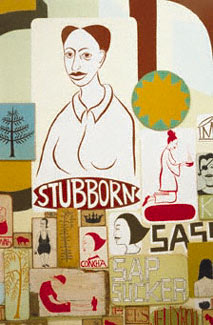 |
| By Margaret Killgalen |
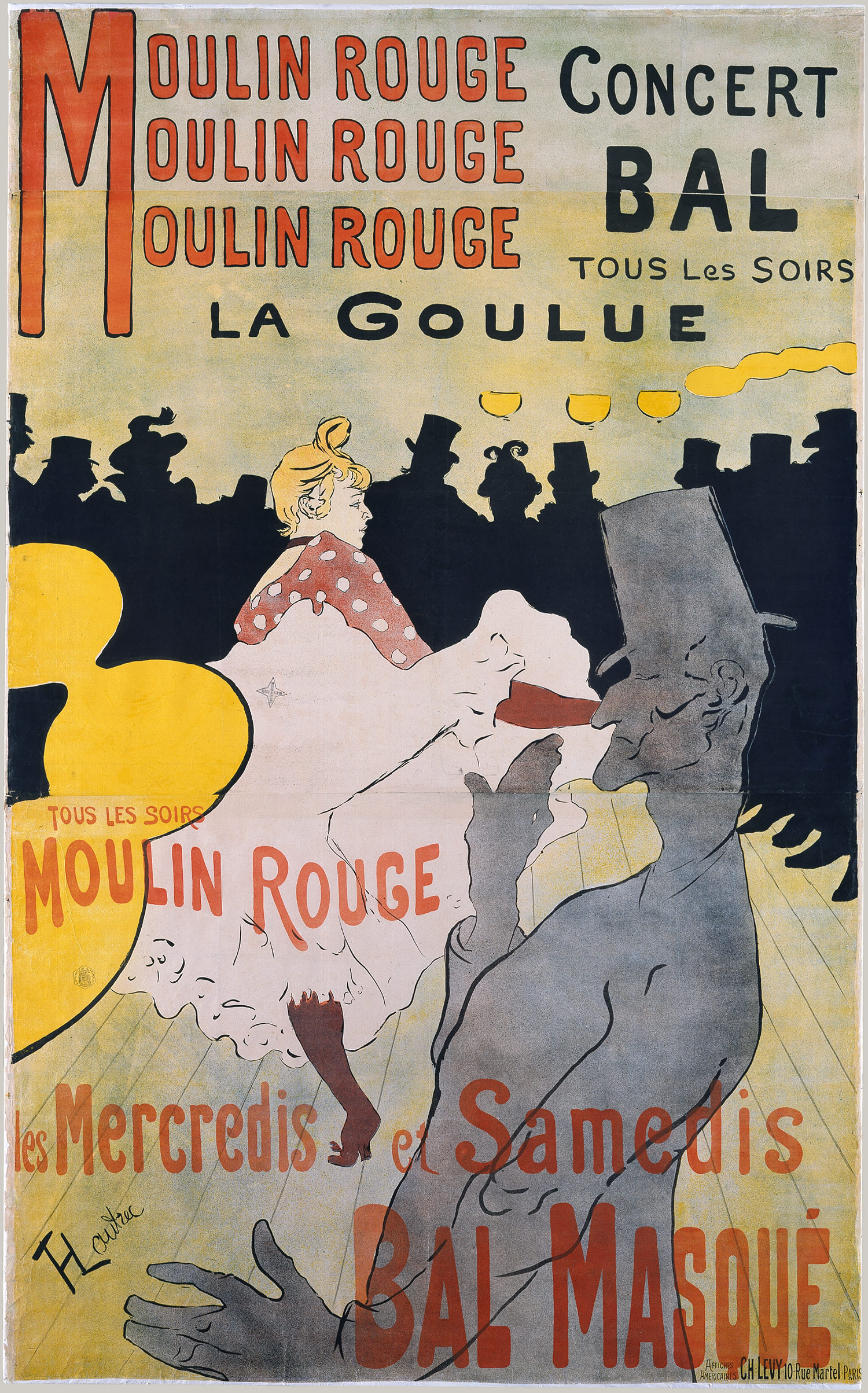 |
| By Henri de Toulouse-Lautrec |
Last but not least, I got to research Margaret Kilgallen, a contemporary print maker. Before I read about her or watched the videos, I looked through her works on Google images to just get a feel of what im going into. Instantly, I saw that they resemble Henri de Toulouse-Lautrec who was a post-impressionist French print-maker. What I found interesting about Kilgallen was that she was not your traditional painter. She was out their painting on trains or walls. She was more like an action painter. Her large scale works are captivating, bold, and aesthetic. I love large scale art, because I like to be encapsulated by it. Kilgallen redefined the canvas. It is not just paper or a piece of fabric on an easel. Her work is a mark she left on something that existed before hand.
Ok, so I talked about Professor Vandenburgh’s lecture, the reading, and Margaret Kilgallen. But how do they all relate to each other? Well, I discovered that they all focus on contemporary art (who would of thought). Contemporary art differs from all the other “arts” is that it has no boundaries or particular definition. In the reading, I found that Duchamp and his idea of a readymade started paving the rocky road of contemporary art. Anything can be art and any kind of medium can be used. To me this piece of cake in the background is a master piece, I’d take that cake over the Monalisa any day. For instance, in Professor Vandenburgh’s lecture, she showed a slide of a man (I really hope it is a man) with his back hair forming many swirls; and this was art. The man’s back was the canvas, just like how Killgalen used the train as a canvas.
Images taken from:

Mohammad - This is an excellent first post. You've covered all the necessary components and brought in a lot of your personal experiences and opinions. One thing to work on for future posts are your connections between the readings/multimedia and the lecturer. Dig a little deeper and expand your ideas. Great work!
ReplyDelete