Surprisingly, after a material dense week, this week was kind of like a break. There aren’t many topics to talk about and so it can give me a chance to go into specifics regarding the two topics for this week, our guest speaker Anya Kivarkis and our weekly artist John Feodorov.
Anya talked about a lot of things in her lecture. The lecture revolved around jewelry, metal smiths, and other forms of craft. I always thought that arts and crafts were synonymous. Until recently, I never questioned why it was called “Arts and craft.” Now that I think about it, art, in hierarchal terms, is perceived as being higher than craft. And art is more precious and valued more than craft, which is more of a commodity, something that satisfies a need. Anya talk a lot about this in her lecture. One example is the painting titled “Oil on Aluminum” by Marilyn Minter. I found this painting interesting because it is controversial and ironic. It shows a woman splashing in a puddle of mud in what appears to be designer shoes. Minter questions and smudges the line between art and commodity. Are the shoes a commodity because they satisfy the need to protect ones foot? Or are they are because they are adorned in jewels and carry a designer label? And if it is art, why is she splashing through the mud with them? The medium she used is also significant. Paintings are the traditional form of art, and are automatically labeled as art but it is depicting a craft or commodity which is contradicting in a sense.
Another piece that Anya talked about was by Kim Buck. This piece is a gold tube that is shaped like a ring. People pay certain price to get a portion of this ring. One can pay a whole lot of money and get a good chunk of the gold ring or pay a small amount and receive a thin sliver. This again questions the issue of hierarchy. It separates people based on wealth. I am talking about this piece as a work of art but in reality it is a craft because it satisfies a need; a need for greed. It is mass produced, which reduces it preciousness, yet it is made out of gold. I think that this piece is both a work of art and a craft. It holds elements from each but doesn’t fall only in single one.
Feodorov is one interesting character. He was brought up in the suburbs in Los Angeles and a Navajo reservation in New Mexico. His upbringing and heritage has an obvious effect on his work. One piece a loved and found really amusing was “Totem Teddies.” He took a bunch of bears and put sacred masks on them. In his interview he said “Behind these masks are cuddly cute faces. Its turning these teddy bears into powerful totem symbols sort of giving them back their power. But also they would be products the consumers could buy, so at the same time it would be stripping them of their power. That just sort is an example of the issue of commodifying the issue of spirituality.” I totally agree with him and I love how he played around with this piece to express this ambiguous message. He took something totally sacred and made something the one can purchase, like a teddy bear. I think its brilliant, not because it’s funny but because it really wakes people up. It wakes people up because it shows that some things can’t really be bought, like spiritual enlightenment or moral values.
There definitely is an obvious connections between Feodorov speech and Anya’s lecture. Anya talked a lot about preciousness, hierarchy, and commodity. Feodorov expressed what Anya talked about in his work. Teddy bears are a commodity, they fill the need for comfort and love. Totems are spiritual objects used for religious practices. Put the two together and you get nothing. A commodity can’t be precious, it’s like dividing by zero on calculator; you get a syntax error. And that is exactly what Feodorov did. He took a commodity and made it precious but in reality it is none. Religion these days has become a commodity unfortunately. Religious enlightenment is found in mass consumerism. The more we buy the happier we get… right?
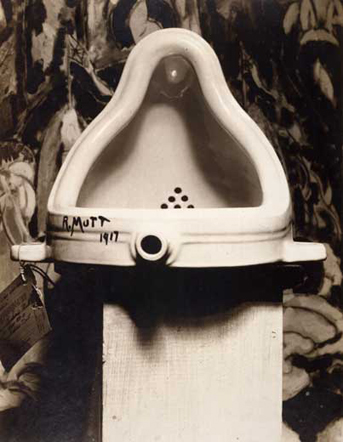
My response for this week is Marcel Duchamp’s “Fountain.” It’s perfect! I mean he took a freakin urinal signed it and make precious. It is like the opposite of Fedorov what did. Instead of making a something precious a commodity, he made a commodity something precious. And pissed off a lot of people in the process as well. And a century later, we still talk about him.